Integrated GRC Framework
Unified Governance, Risk & Compliance Excellence
The GCC Governance Challenge
Boards across the GCC face a governance paradox: regulatory expectations accelerate while decision cycles compress. Audit findings accumulate, stakeholder inquiries intensify, and assurance lanes blur—yet adding more controls creates bureaucracy that slows decisions. The cost is measurable: delayed approvals, fragmented ownership, and governance that records incidents rather than prevents them.
Mithaq360 provides integrated GRC advisory that consolidates policy frameworks, builds decision-useful indicator systems, and establishes assurance-ready evidence—enabling boards to govern with confidence rather than react to findings.
Regulatory Shift and Sovereign Expectations
Organizations report three critical pressures: alignment with Vision 2030 transformation objectives and national KPIs, bilingual governance frameworks where Arabic documentation carries authoritative weight, and sovereign shareholder expectations for comparable options with transparent trade-off rationale.
Decision Quality versus Compliance Theatre
Leaders distinguish between governance that sharpens choices and governance that produces reports. Effective GRC delivers indicators that predict exposure before incidents occur, clause-to-control mapping with clear evidence trails, and decisions documented with transparent rationale.
Fragmented Systems and Unclear Accountability
Common symptoms include policy stacks managed across departments without coordination, compliance and risk functions using different taxonomies, and indicator registers with ambiguous ownership and unclear data lineage.
What You Get
Unified Management Systems - Single Integrated Corporate Governance Framework that unifies governance architecture, risk management, compliance obligations, and integrity controls.
Standards-Based Integration - Leverage modern ISO management system standards that share the Annex SL high-level structure, enabling one policy suite, one control catalogue, one indicator register, and one assurance calendar.
Decision-Grade Evidence - Clause maps linking ISO requirements to controls, indicator registers with documented lineage, and Value Notes capturing decision rationale with trade-offs and confidence levels.
Regional Delivery Excellence - Native Arabic capability through Paramount Value Consulting Group in Riyadh, with established relationships with CMA and SAMA, plus experience with PIF portfolio governance requirements.
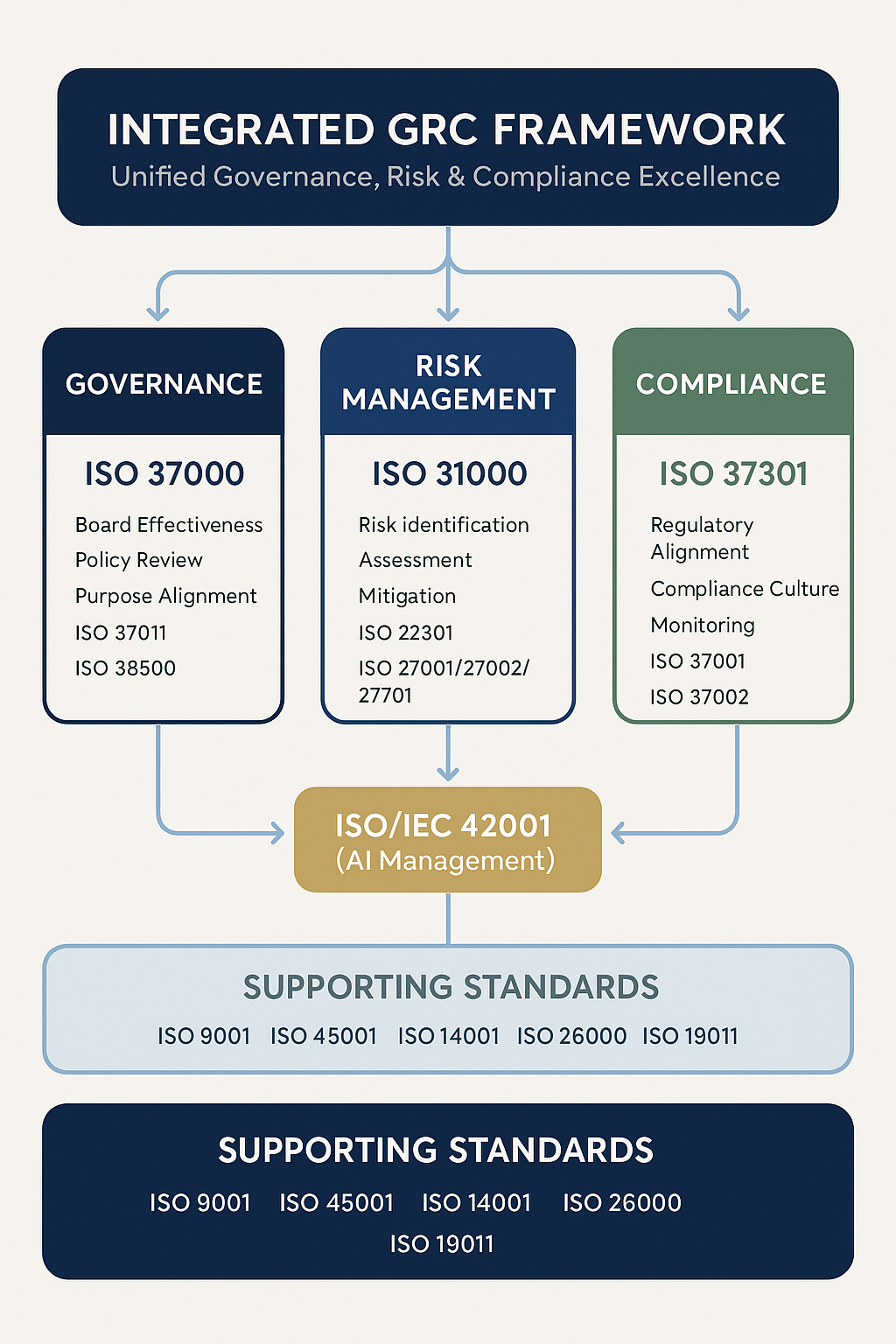
Integrated GRC Framework Overview
Deliverables
All deliverables are reviewer-grade artifacts prepared for third-party assurance and regulatory scrutiny.
- •Integrated Corporate Governance Framework (ICGF) aligning ISO 37000, ISO 31000, ISO 37301, and ISO/IEC 42001
- •Unified policy suite and control catalogue serving multiple standards concurrently
- •Single indicator register with documented ownership, quality ratings, and assurance paths
- •Consolidated assurance calendar reducing audit friction and duplication
- •Clause-to-control mapping with clear evidence trails and acceptance criteria
- •Value Notes documenting decision rationale, trade-offs, uncertainty ranges, and confidence levels
- •Bilingual governance documentation (Arabic and English) with authoritative Arabic weight
- •Risk appetite frameworks embedded into decision-rights and governance processes
- •Board reporting systems delivering decision-useful insights and predictive indicators
- •Vision 2030 alignment framework with transparent trade-off documentation
The Process
Current State Assessment
Comprehensive review of existing governance, risk, and compliance frameworks to identify fragmentation, gaps, and integration opportunities.
- Document existing policy frameworks across governance, risk, and compliance functions
- Map current control catalogues and identify overlaps or gaps
- Review indicator registers and assess data lineage and ownership clarity
- Analyze assurance schedules and identify duplication or coverage gaps
- Interview key stakeholders to understand decision-making friction points
Integrated Framework Design
Design unified GRC architecture leveraging ISO Annex SL structure to consolidate systems while maintaining compliance with multiple standards.
- Develop Integrated Corporate Governance Framework (ICGF) structure
- Create unified policy suite mapping to ISO 37000, ISO 31000, ISO 37301, and ISO/IEC 42001
- Design single control catalogue with clear clause-to-control linkages
- Build consolidated indicator register with documented lineage and assurance paths
- Establish risk appetite framework embedded in decision-rights
Implementation and Integration
Deploy integrated systems, train teams, and establish governance processes that connect strategy with oversight.
- Implement unified policy suite with bilingual documentation
- Deploy consolidated indicator register and reporting dashboards
- Train governance, risk, and compliance teams on integrated approach
- Establish consolidated assurance calendar and audit protocols
- Create Value Notes templates for decision documentation
Assurance Readiness
Prepare evidence trails, conduct pre-assessment reviews, and ensure frameworks are ready for third-party verification.
- Conduct internal audit of integrated framework against ISO requirements
- Prepare clause maps and evidence packages for external assurance
- Review indicator quality ratings and data validation processes
- Test board reporting systems for decision-usefulness
- Document Vision 2030 alignment and sovereign stakeholder requirements
What Makes This Different
ISO Standards Expertise
As co-authors of ISO 37000 and experts in ISO 31000, ISO 37301, and ISO/IEC 42001, we bring deep standards knowledge to GRC integration.
Regional Context
Native Arabic capability with deep understanding of Vision 2030 requirements, sovereign shareholder expectations, and GCC regulatory landscape.
Evidence-Based Approach
Every implementation produces reviewer-grade artifacts with documented lineage, acceptance criteria, and transparent decision rationale.
Unified Systems Thinking
We eliminate fragmentation by designing one integrated framework that serves multiple standards, reducing complexity and cost while improving oversight.